
From Lab Bench to Boardroom: A Founder’s Roadmap for Launching a Biotech Startup
I gave a seminar this past May at the SmartSciFrika Virtual Conference 2026 about the practical approach to launching the biotech startup. Turning an innovative scientific concept into a life-saving therapeutic is one of the most rewarding—and grueling—journeys an entrepreneur can take. Unlike traditional tech startups where a minimal viable product can be coded in a weekend, therapeutic development operates on an entirely different scale.
Navigating the transition from academic research to a market-ready drug requires an average of 15 years from preclinical research to final FDA approval. Along the way, candidates face a steep gauntlet: only about 10.4% of products successfully cross the finish line from Phase 1 through to approval.
To survive this marathon, early-stage founders must master the "Biotech Phase"—the critical window spanning early research, preclinical development, and the eventual Investigational New Drug (IND) submission. If you are preparing to spin out a company, here is a foundational roadmap to protect your science, execute a lean operational plan, and secure capital.
1. Protecting the Spark: The IP and Licensing Pipeline
Before you build a team or rent lab space, you must secure your intellectual property (IP). In biotech, your IP is your company's value. Academic professionals and universities hold a wealth of high-demand inventions, but moving them into a startup requires a structured five-step pipeline:
DISCOVER ➔ DISCLOSE ➔ ANALYSIS ➔ PROTECT ➔ LICENSE
The Realities of Patent Protection
The Clock is Ticking: The protection process typically begins by filing a provisional patent application. Founders then have exactly one year to file a U.S. non-provisional application before the provisional expires.
Expect Delays: Patience is mandatory. It can take up to six years to officially obtain a U.S. patent.
High Financial Barriers: Protecting IP is capital-intensive. Expect to spend approximately $25,000 for U.S. patent protection and up to $150,000 for international coverage.
Navigating University Licensing
When licensing technology back from an academic institution, university licensing professionals will negotiate terms to ensure a fair return for both the inventor and the institution. Keep these variables in mind:
Scope & Exclusivity: Exclusive licenses grant sole rights but generally cost significantly more than non-exclusive options. Consider whether your business model requires a broad field of use or can be limited in scope.
Duration: License terms can last for just a few years or extend for the entire life of the patents.
The Academic Caveat: In virtually all university tech-transfer agreements, the original academic inventor retains the right to continue conducting non-commercial research using the technology.
2. Executing a Lean Plan: Starting Small
When it comes to initial execution, the golden rule is start-up before you scale-up. Instead of replicating a traditional corporate hierarchy (with isolated executives, massive legal teams, and bloated operations), successful modern biotechs deploy an agile operational framework.
The 1-FTE "Jack of All Trades" Model
In year one, your focus should be maximizing internal scientific capabilities while keeping headcount extraordinarily lean. Hiring a single, highly adaptable Full-Time Equivalent (FTE) who can wear multiple hats allows you to establish core workflows:
Internal Capabilities: Focus your internal energy on target selection and design, core RNA synthesis, target expression, cell-based assays, and cell imaging.
Leveraging External CROs: Do not build heavy infrastructure early. Outsource capital-heavy or highly specialized tasks—such as scale-up RNA/DNA synthesis, Next-Generation Sequencing (NGS), and complex in vivo animal models—to established Contract Research Organizations (CROs).
Utilizing Biotech Incubator Spaces
Avoid long-term commercial real estate leases. Newly renovated incubator spaces offer a competitive cost structure designed for early-stage survival, providing immediate access to, for example:
Advanced shared instrumentation, such as flow cytometers and live-cell imaging platforms
Fully equipped Biosafety Level 2 (BSL2) tissue culture labs and shared fume hoods.
Liquid nitrogen (LN2) storage and ultra-low temperature freezers.
A Sample Year-One Blueprint Budget
To give you a sense of what a lean, capital-efficient first year looks like, consider this baseline operational budget totaling >200,000 USD:
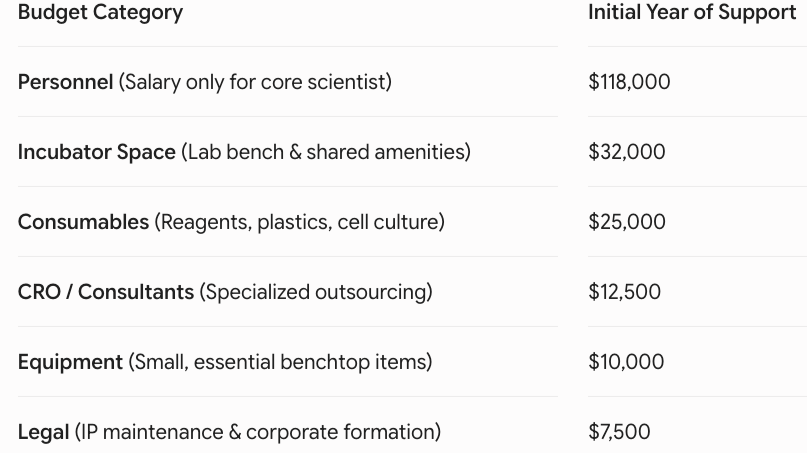
Table 1: Sample Year-Budget for a Wet-lab Biotech Startup
3. Funding Strategies and the Exit Horizon
An agile operational plan is only as good as the capital backing it. Biotech startups typically pull from five traditional funding buckets: Venture Capital (VC), Angel Investors, non-repayable Grants (government agencies or foundations), bank Loans, and Crowdfunding (including friends and family).
As a founder, your fundraising efforts will be stage-gated by clear valuation milestones:
Pre-Seed ➔ Seed / Startup ➔ Early Stage ➔ Growth ➔ Exit
Pre-Seed: Driven by founders, friends, and family. Typical funding hits around $50K with a company valuation between $10K–$100K.
Seed / Startup: Funded via personal savings, credit cards, incubators, angel investors, or early grants. Funding ranges from $10K to $3M, establishing a valuation of $3M–$6M.
Early Stage: Accelerators, micro-VCs, and specialized bank loans come into play. Funding scales to $2M–$15M with valuations climbing to $10M–$30M.
Growth Stage: Powered by institutional Venture Capital firms, late-stage VCs, and mezzanine funding. Rounds average $30M on valuations of $30M–$60M.
The Exit: Late-stage VCs, private equity firms, or public markets via an Initial Public Offering (IPO). Funding rounds routinely exceed $50M+ with valuations targeting $100M+.
Key Pillars for Operational Success
Regardless of your current funding round, three operating principles should guide your leadership:
Creativity: Constantly re-evaluate and understand exactly what is essential for your team to hit its next data inflection point.
Open Communication: Foster an environment where scientific teams immediately convey raw results—and potential risks—to leadership without fear.
Oversight: Remember that taking institutional money changes the rules. Accepting VC funding will require transitioning to a formal Board of Directors to guide corporate governance.
Useful References for Aspiring Founders
If you are ready to dive deeper into planning your biotech venture, consider adding these essential reads to your bookshelf:
The Entrepreneur's Guide to a Biotech Startup by Peter Kolchinsky, Ph.D. (Published 2004) – Though some market metrics are older, this 98-page guide remains a foundational text freely available online, outlining universal principles of biotech valuation and strategy.
The Honorable Entrepreneur by Philipp Baaske (Published 2021) – A 178-page personal approach detailing how to build an impactful life sciences technology business organically without relying heavily on traditional venture capital.
Building Backwards to Biotech by Stephanie A. Wisner (Published 2022) – A comprehensive, 373-page modern guide analyzing how to successfully translate cutting-edge academic science into viable, market-driven commercial therapeutics.
Other References:
IP Licensing: https://bridge.umassmed.edu/s/faculty-and-inventors/resources-and-policies
Startup Funding: https://www.lifesciencesmarketing.nl/biotech-startup-funding/
Funding Rounds: https://nowcfo.com/rounds-of-funding-for-start-ups/
Phases of Therapeutic Development: https://www.cognidox.com/blog/biotech-startup-companies-how-to-take-on-pharma-giants-and-win
Massachusetts Biomedical Initiatives: https://mbi.bio/